
The push for faster federal permits is bigger than the headline projects, and so is the opportunity.
Permitting has never been a fashionable topic in federal IT. It lives where every unglamorous back-office function lives: underfunded, under-modernized, and mostly invisible outside the agencies that had to run it. That changed on April 15, 2025, when the White House issued a Presidential Memorandum, “Updating Permitting Technology for the 21st Century,” directing the Council on Environmental Quality (CEQ) to build a Permitting Technology Action Plan (PTAP) and stand up a Permitting Innovation Center. Six weeks later, CEQ delivered ten minimum functional requirements, a shared data and technology standard, and a maturity model that agencies are now expected to meet.
The near-term catalyst for that push came in the form of faster reviews for energy, mining, and infrastructure projects. The Federal Permitting Dashboard's active project portfolio grew 158% between FY 2024 and FY 2025. The Permitting Council's own reporting to Congress shows the majority of that growth came from mining and pipeline projects moving through FAST-41, a federal program that gives a small set of large, complex infrastructure projects a dedicated case manager, a public timetable, and priority coordination across every agency that has to sign off.
That context is worth knowing, but it's less important than what it produced. Permitting has needed this level of technical investment for years, regardless of which administration eventually got around to funding it or why. The standards CEQ published, the maturity model it set, and the case it built for modernization are in place, and agencies are well positioned to use them.
The Dashboard is the Tip of a Much Bigger Pyramid
Let’s start with what's visible. There were 85 active FAST-41 projects in FY 2025, with each one large and complex enough to warrant a public timetable and a dedicated Permitting Council advisor. These are all legitimate and useful things to have modernized.
They also make up a tiny fraction of federal permitting.
Under the National Environmental Policy Act (NEPA), every federal action that could affect the environment gets sorted into one of three levels of review. At the top is the full Environmental Impact Statement, the months-or-years-long process reserved for the largest, most consequential projects. Below sits the Environmental Assessment, a shorter study for projects whose impact is less certain. And at the below that, covering the vast majority of federal actions, is the Categorical Exclusion: a determination that a routine action does not significantly affect the environment and can proceed without a full study. For example, this would be projects like a trail repair, a small special-use permit, or a routine right-of-way renewal. These are the kinds of actions where a categorical exclusion clears quickly, and they make up the overwhelming majority of federal permitting activity by volume.
CEQ's own Permitting Technology Action Plan puts the real scale of the problem at roughly 1.5 million permitting actions per presidential term. About 400,000 of those are categorical exclusions under NEPA, which CEQ's guidance identifies as the most frequently used level of environmental review by a wide margin. The Army Corps of Engineers alone processes an average of roughly 63,000 activities a year through nationwide and other general permits, accounting for more than 97 percent of its total regulatory workload. Compare that to Environmental Impact Statements (the review level the FAST-41 dashboard was built almost entirely to track) government-wide: only about 100 to 200 get completed in a typical year.
Finally, there's an entire category of permits that never touch the NEPA review process at all. These non-NEPA permits are things like;
- National Park Service special-use, commercial-use, and concession permits;
- Fish and Wildlife Service ESA Section 7 consultations and incidental-take permits;
- Forest Service special-use authorizations;
- EPA and state-delegated Clean Water and Clean Air permits running into the hundreds of thousands a year.
These are the permits that actually reach the majority of people who interact with the federal government. Examples include a concessioner renewing an operating agreement, a rancher waiting on a grazing permit, and a small utility waiting on a right-of-way. And today they are, almost without exception, still running on the fragmented, paper-adjacent systems CEQ's own plan describes as “foundational,” the lowest level on its maturity model.
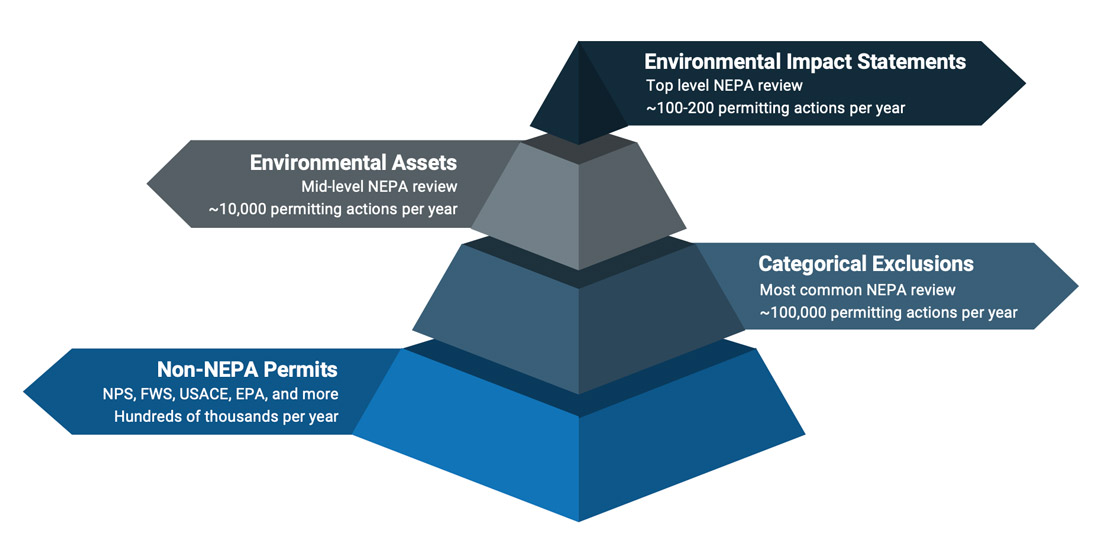
Permitting Review Process Pyramid
What the Base of the Pyramid Actually Looks Like
At Arctic IT Government Solutions (AITGS), we know this terrain firsthand. AITGS rebuilt the Office of Subsistence Management's Alaska Subsistence Permitting system, replacing a legacy database that couldn't support multi-factor authentication with a modern Power Platform application and public-facing portal. That system manages hunting and fishing permit applications, harvest reporting, and regulatory actions for subsistence communities across rural Alaska. This was not the case of a single applicant with a nine-figure project and a lobbyist. For these residents, a trip to town to mail a paper form was the real burden. In some cases, it was submitting a harvest report from a rural village, on a system that until recently required phone or mail.
This is exactly the type of operational reality CEQ's Permitting Technology Action Plan is describing when it calls for automated case management, milestone tracking, and structured document handling. The plan was written with large infrastructure projects in mind, but the ten minimum functional requirements it lays out are not infrastructure-specific.
These requirements include:
- Shared data standards
- Automated screening
- Case management on an underlying event store
- Integrated GIS analysis
- Digital-first documents
- An assembled administrative record and more
They are the basic architecture of any modern permitting operation, whether the case in front of a reviewer is a natural gas pipeline or a campground concession. Having built permitting architecture at scale is what makes the CEQ plan look, to us, less like a new mandate and more like a confirmation of a direction we were already headed.
Riding the Wave, Wherever Your Agency Sits
If you're an agency with a permitting function (not just the ones working on headline infrastructure projects), the time to move is now. The standards exist. The maturity model exists. The vocabulary for making the case to appropriators and inspectors general exists, because CEQ already wrote it. Agencies that treat this as someone else's initiative because they don't process pipeline permits are leaving a fully built technology and funding rationale on the table.
That's the thinking behind ArcticPass, AITGS’s permitting and approvals platform built on Microsoft Power Platform and Azure. We designed it around the same building blocks CEQ's plan calls for:
- Digital intake portals
- Workflow automation and interagency routing
- Milestone tracking across permit types
- Public comment intake, and reporting dashboards with a full audit trail, but sized for the high-volume
- Repeatable permitting that makes up the base of the pyramid, not just the marquee projects at the top
It runs on the same FedRAMP-authorized Microsoft cloud infrastructure most agencies already own, which means modernizing doesn't require replacing a legacy system that still works. It requires building the case-management layer on top of it.
The Best Time to Act is Before the Backlog Forces the Issue
Permitting has real momentum right now, and that momentum has produced something genuinely useful. The Permitting Technology Action Plan is a technology standard and a maturity model every permitting agency can build toward. Agencies that use this window to modernize the unglamorous, high-volume permitting they actually run (the base of the pyramid, not the tip) will come out of it with real operational improvement. In the real world, that means faster reviews, fewer backlogs, better records, and a defensible case that they got ahead of a requirement before it became one.
AITGS has done exactly this type of work, including rebuilding OSM's Alaska Subsistence Permitting system. We built ArcticPass because we are repeatedly seeing the same gap: excellent people running high-volume permitting programs with none of the case-management tooling the work requires. If your agency issues permits at any volume, NEPA-adjacent or not, this is the moment to have that conversation, not after the backlog becomes the story.
Connect with AITGS today to get started on your permitting modernization journey.

By Robin Zickgraf, Account Executive at Arctic IT Government Solutions
About the Author
Robin Zickgraf is a Federal Account Executive at Arctic IT Government Solutions, where he works with agencies on IT modernization across Microsoft cloud platforms, including permitting and case-management programs. He helped shape ArcticPass, AITGS's permitting and approvals platform, built specifically for the high-volume, repeatable permitting work most modernization efforts overlook. Robin can be reached at [email protected].